

Codex adopts international standards and discusses new food sources and production systems
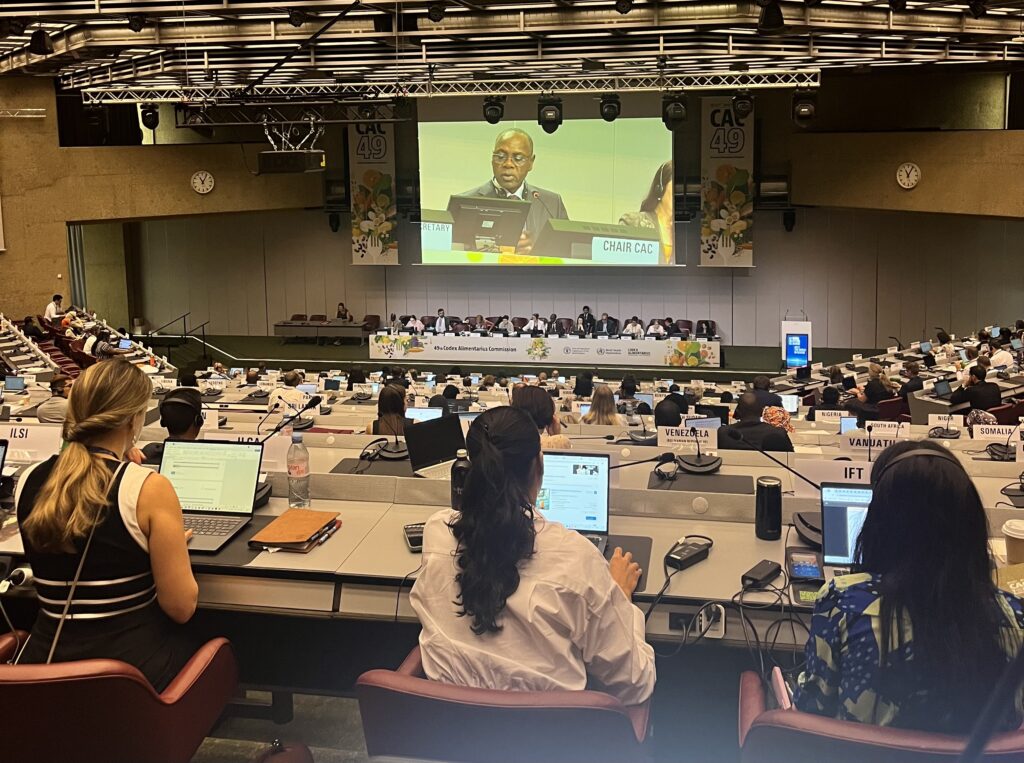
This has been an amazing week reconnecting with colleagues and friends during the 49th Session of the Codex Alimentarius Commission (CAC49), 6-10 July in Geneva.
I had very engaging discussions with long-standing colleagues and new ones, resulting in ideas and plans for exciting new projects to help shaping regulatory frameworks in key regional and national markets, taking into account Codex standards and guidelines.
It is always so special to reconnect with people who are part of the Codex journey for years while making new connections.
CAC49 adopted key international standards and guidelines on:
– spices and culinary herbs;
– food higiene for fishery products and chicken meat;
– maximum residues limits of veterinary drugs in foods;
– the condicions of use of food additives in key food product categories;
– the use of precautionary allergen labelling (PAL), food labelling requirements relevant to joint presentation and multipack formats, or the application of food labelling rules in emergency situations;
– microbial omega-3 oils in food and food supplements (Step 5);
– among others.
In addition, an electronic Working Group was established to identify areas where CAC could elaborate guidance on New Food Sources and Production Systems (also known as novel foods) and prepare a report with a new work proposal for next year.
Last but not least, CAC49 discussed again the work underway by the World Health Organisation (WHO) on ultra-processed foods (UPF), considering its intent to recommend regulatory measures on UPF, taking into account the NOVA classification. The outcome of the WHO work will be relevant to further future Codex discussions on UPF.
The Codex Alimentarius Commission (CAC) serves as the leading international body for the development of science-based food standards, bringing together governments, scientific experts, international organizations, consumer groups, academia, and representatives from the private sector in a transparent and inclusive standard-setting process.
Collaboration between the public and private sectors, the academia and consumer groups is a fundamental component of the Codex system that strengthens the quality and applicability of Codex standards to existing food commodities and new foods resulting from innovative technologies.